
EMS Zero for the Muscles That Support Your Back
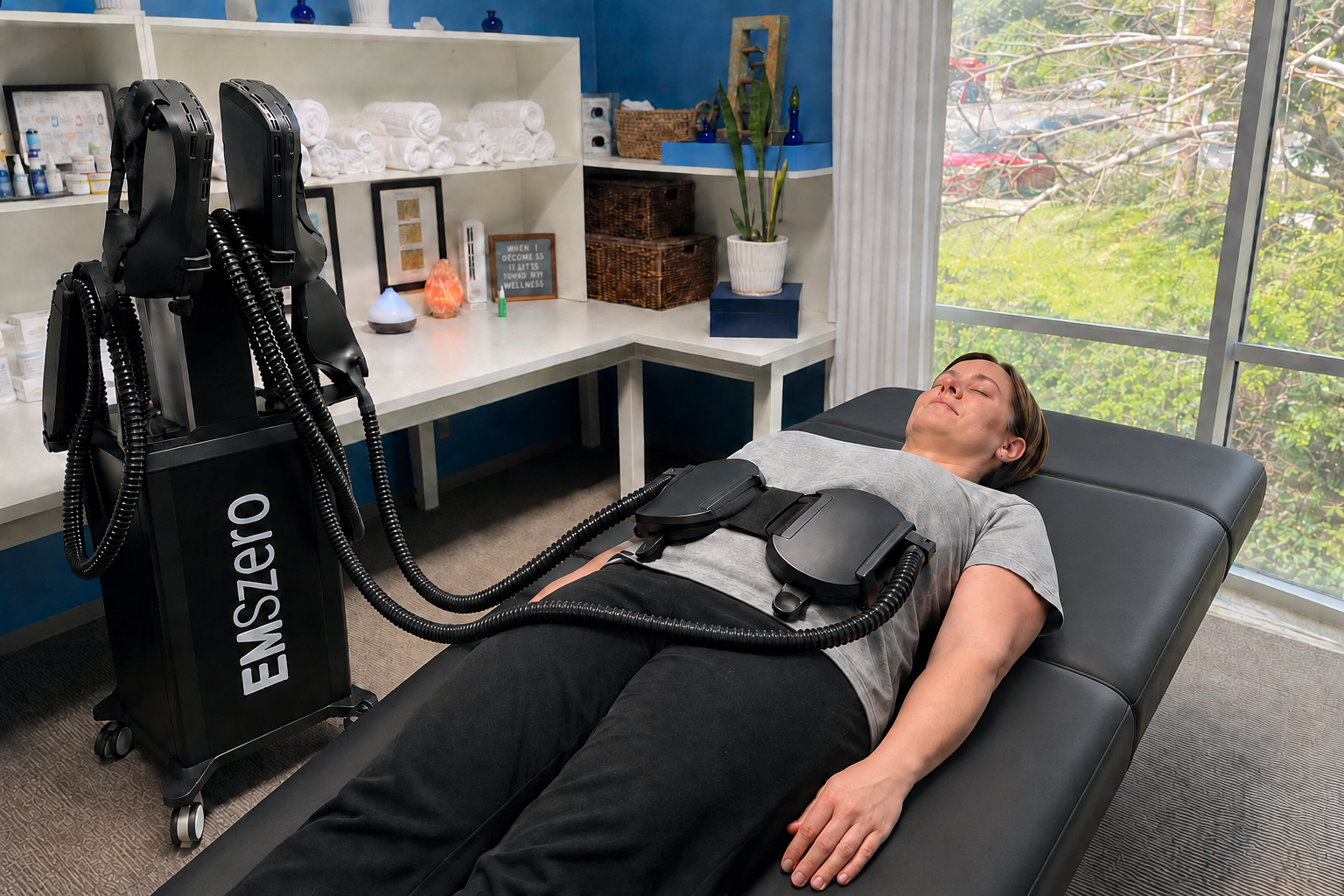
EMS Zero for the Muscles That Support Your Back at Enlighten Red Light Therapy Center
What EMS Zero actually does
EMS Zero uses electromagnetic energy to produce repeated contractions in the muscles beneath its applicators. When the paddles are positioned over the abdomen or glutes, those muscles work while you remain stationary during the 30-minute session.
That makes EMS Zero relevant to back support, but the distinction matters. Your lower back does not carry the body by itself. The abdominal wall, glutes, hips, pelvic floor, and deeper spinal muscles help stabilize the trunk and distribute force when you stand, lift, turn, and walk. Conditioning those muscles may improve how the body shares that load.
EMS Zero is a muscle-conditioning tool. It does not diagnose the source of back pain, repair an injured structure, or replace appropriate medical care. The useful question is whether strengthening part of the support system fits the problem you are trying to solve.
At Enlighten Red Light Therapy Center, the EMSzero Neo system can use one to four body paddles during a session. Another configuration uses two body paddles with the seated pelvic-floor attachment. The configuration depends on which muscles are being targeted and what the screening process shows.
Each applicator sends pulses of electromagnetic energy into the treatment area. Those pulses activate motor nerves, which cause the targeted muscles to contract and release without requiring you to perform a conventional exercise. The intensity starts lower and increases within your tolerance.
The contractions are the point. They place repeated demand on the muscle, much as voluntary contractions do during exercise. EMS Zero can therefore provide concentrated work for abdominal or gluteal muscles, including muscles that may be difficult for some people to recruit deliberately.
EMS Zero is also different from TENS unit. TENS uses electrical current delivered through adhesive electrodes and is generally used to influence sensory nerves and pain signaling. EMS Zero uses magnetic stimulation to activate motor nerves and produce muscular contractions. The technologies may sound similar because both involve stimulation, but they are built for different jobs. A peer-reviewed review of TENS mechanisms and clinical use explains the sensory-nerve focus of TENS.
Why the core matters to the lower back
The spine is part of a larger mechanical system. When you rise from a chair, carry a bag, walk up a flight of stairs, or reach into the back seat of a car, force moves through the trunk, pelvis, and hips. Several muscle groups help control that force:
The abdominal wall manages pressure and resists unwanted trunk movement.
The obliques control rotation and side bending.
The multifidus and other small muscles near the spine help control movement between spinal segments.
The erector spinae extend the trunk and help keep it upright under load.
The gluteal muscles control the hips and pelvis while you stand, walk, lift, and change direction.
The diaphragm and pelvic floor work with the abdominal wall and deeper spinal muscles to manage pressure through the trunk.
This is less like wearing a rigid brace and more like sharing weight across several points of contact. If one part of the system has less capacity, another part often carries more of the work. Building muscle capacity does not explain every sore back, but it is a legitimate part of an active plan, particularly after inactivity or when rebuilding strength and movement tolerance.
The broader evidence supports exercise and active care for many people with chronic nonspecific low-back pain. The 2021 Journal of Orthopaedic & Sports Physical Therapy clinical practice guideline includes trunk strengthening, endurance exercise, specific trunk activation, and movement-control training among its recommendations. A large Cochrane review of exercise therapy found that exercise probably reduces pain in people with chronic low-back pain compared with no treatment, usual care, or placebo.
EMS Zero belongs beside movement, not in place of it.
Where EMS Zero may fit
The value of a session is not measured by how dramatic the contractions feel. The real question is whether the targeted muscles gain enough capacity to do more of their share during ordinary movement.
For an appropriately screened adult, EMS Zero can provide a way to:
Put repeated demand on selected abdominal or gluteal muscles
Add muscular work to a walking, strength, mobility, or rehabilitation plan
Rebuild general conditioning after inactivity, when medically appropriate
Work a selected muscle group without repeated voluntary movement during the session
Practice engaging muscles that have been difficult to recruit deliberately
The mechanism is clear: magnetic stimulation produces contractions, and repeated contractions create muscular work. The part that varies is what that work produces for a particular person. Health history, activity level, treatment settings, applicator placement, session frequency, and the actual source of the symptoms all affect the result.
What the research shows, and what it does not
A 2023 meta-analysis reviewed six randomized trials involving 139 participants and found possible benefits from repetitive peripheral magnetic stimulation for low-back pain. The full study is available through PubMed.
A second randomized study examined magnetic stimulation of the multifidus muscles combined with motor training. It found changes in measures of motor control and chronic low-back pain, but the trial included only 21 people. The study can be reviewed through PubMed.
EMS Zero has a real muscle-contraction mechanism. Related research provides a reason to study magnetic stimulation further. Neither point proves that this specific service will relieve a particular person's back pain.
What happens during a 30-minute session
Before the session, Enlighten reviews what you are trying to accomplish, which muscles you want to target, relevant health history, and any reason electromagnetic stimulation may be inappropriate. If the service fits, the staff selects one of two basic configurations:
One to four body paddles placed over selected muscle groups
Two body paddles used with the seated pelvic-floor attachment
The applicators are secured, the intensity begins at a lower setting, and the targeted muscles contract repeatedly while you remain stationary. The sensation can be strong and unfamiliar. Staff adjusts the intensity within your tolerance throughout the session.
Muscular fatigue or soreness can follow a session. What matters afterward is not merely whether you felt the machine working, but whether the service remains tolerable, whether you can engage the targeted muscles more readily, and whether it supports what you are doing outside the center.
Many Enlighten clients choose two or three sessions per week because muscle conditioning depends on repeated work. That is not a universal prescription or a guaranteed timeline. Frequency should reflect your goal, health history, tolerance, response, device protocol, and any guidance you are already receiving from a qualified clinician.
The pelvic-floor attachment
The pelvic floor participates in pressure management with the diaphragm, abdominal wall, and deeper spinal muscles. That relationship makes pelvic-floor function relevant to trunk control, but it does not turn every back problem into a pelvic-floor problem.
Research on pelvic-floor strengthening exercises has reported possible benefits for some people with low-back pain. The cited systematic review is available through PubMed.
Where Red Light Therapy fits
Red Light Therapy and EMS Zero are separate tools. Red Light Therapy applies Red and Near-Infrared light to tissue. EMS Zero uses electromagnetic energy to create muscle contractions.
At Enlighten, someone may use Red Light Therapy for recovery support, EMS Zero for muscle conditioning, or both services as parts of a broader wellness routine.
When EMS Zero is the wrong starting point
Muscle conditioning is not the first step when back pain is unexplained, rapidly worsening, or accompanied by signs of a potentially serious condition. Seek prompt medical evaluation if back pain occurs with:
New loss of bowel or bladder control, or difficulty urinating
Numbness in the groin, inner thighs, or saddle area
Progressive weakness in one or both legs
Severe pain after a significant fall, collision, or other trauma
Fever or other signs of systemic illness
Unexplained weight loss
A history of cancer
Severe, rapidly worsening, or persistent unexplained pain
These signs do not identify the cause by themselves. They indicate that the cause deserves medical evaluation before a wellness service enters the conversation. NICE guidance on assessing low-back pain provides additional context for screening and escalation.
Electromagnetic muscle stimulation is not appropriate when you have an implanted electronic device, metal near the intended treatment area, pregnancy or possible pregnancy, active cancer, a significant heart condition, a seizure disorder, recent surgery, a hernia, an open wound, or infection.
Frequently asked questions
Can EMS Zero help with lower-back discomfort?
EMS Zero can condition abdominal or gluteal muscles that contribute to trunk and pelvic control. Better conditioning may help some people distribute load more effectively during movement.
How does EMS Zero condition the core?
Pulsed electromagnetic energy activates motor nerves and produces repeated contractions in the targeted muscles. Those contractions place demand on the muscle while you remain stationary.
Is EMS Zero the same as TENS?
No. TENS uses electrical current delivered through skin electrodes and generally targets sensory nerves involved in pain signaling. EMS Zero uses magnetic stimulation to activate motor nerves and produce muscular contractions.
Does EMS Zero replace exercise or physical therapy?
No. Exercise has stronger evidence for chronic nonspecific low-back pain, and physical therapy provides individualized evaluation and rehabilitation when needed. EMS Zero can add muscular work to an active plan when screening shows that it fits.
What happens during an EMS Zero session?
A session lasts 30 minutes. Enlighten can use one to four body paddles, or two body paddles with the seated pelvic-floor attachment. The targeted muscles contract repeatedly while you remain stationary, and staff adjusts the intensity within your tolerance.
How often do people schedule sessions?
Many Enlighten clients choose two or three sessions per week. The right frequency depends on your goal, health history, tolerance, response, device protocol, and any clinician-directed plan already in place.
Does the pelvic-floor attachment treat back pain?
The attachment creates muscular work in an area that participates in trunk pressure management. Research involving pelvic-floor exercise cannot establish a back-pain result for Enlighten's seated attachment.
Ready to get started?
Our skilled Technicians can help guide you to success in building specific muscle groups. The best way to find out if this is the path forward for you is to have an experience. This service can be done alone or paired with Red Light Therapy. Click below to book your next appointment. Get started today!
Works Cited
Diao, Y., Pan, J., Xie, Y., Liao, M., Wu, D., Liu, H., & Liao, L. (2023). Effect of repetitive peripheral magnetic stimulation on patients with low back pain: A meta-analysis of randomized controlled trials. Archives of Physical Medicine and Rehabilitation, 104(9), 1526–1538. https://doi.org/10.1016/j.apmr.2023.03.016
George, S. Z., Fritz, J. M., Silfies, S. P., Schneider, M. J., Beneciuk, J. M., Lentz, T. A., Gilliam, J. R., Hendren, S., Norman, K. S., Beattie, P. F., Bishop, M. D., Goertz, C., Hunter, S., Olson, K. A., Rundell, S. D., Schmidt, M., Shepard, M., & Vining, R. (2021). Interventions for the management of acute and chronic low back pain: Revision 2021. Journal of Orthopaedic & Sports Physical Therapy, 51(11), CPG1–CPG60. https://doi.org/10.2519/jospt.2021.0304
Hayden, J. A., Ellis, J., Ogilvie, R., Malmivaara, A., & van Tulder, M. W. (2021). Exercise therapy for chronic low back pain. Cochrane Database of Systematic Reviews, 2021(9), CD009790. https://doi.org/10.1002/14651858.CD009790.pub2
Johnson, M. I. (2007). Transcutaneous electrical nerve stimulation: Mechanisms, clinical application and evidence. Reviews in Pain, 1(1), 7–11. https://doi.org/10.1177/204946370700100103
Kazeminia, M., Rajati, F., & Rajati, M. (2023). The effect of pelvic floor muscle-strengthening exercises on low back pain: A systematic review and meta-analysis on randomized clinical trials. Neurological Sciences, 44(3), 859–872. https://doi.org/10.1007/s10072-022-06430-z
Massé-Alarie, H., Beaulieu, L.-D., Preuss, R., & Schneider, C. (2017). Repetitive peripheral magnetic neurostimulation of multifidus muscles combined with motor training influences spine motor control and chronic low back pain. Clinical Neurophysiology, 128(3), 442–453. https://doi.org/10.1016/j.clinph.2016.12.020
National Institute for Health and Care Excellence. (2024, October). Back pain - low (without radiculopathy): How should I assess a person with low back pain? NICE Clinical Knowledge Summaries. https://cks.nice.org.uk/topics/back-pain-low-without-radiculopathy/diagnosis/assessment/