
The New Year Demands Reflection: Skipping It Undermines What Comes Next
The New Year Demands Reflection: Skipping It Undermines What Comes Next
The New Year Demands Reflection: Skipping It Undermines What Comes Next
The turning of the year has never been a neutral event. Across civilizations, the arrival of a new year was a structural threshold, a moment requiring an accounting before forward movement could responsibly occur. This instinct predates modern calendars, productivity culture, and self-improvement narratives. Long before the language of goals and resolutions, human societies recognized a simpler truth: time passes whether it is integrated or not, and unintegrated time accumulates cost.
Ancient cultures marked the new year in alignment with forces that mattered for survival—seasons, harvests, and astronomical shifts. The Babylonians observed Akitu following the vernal equinox; Persian cultures celebrated Nowruz at the return of spring; and East Asian civilizations developed lunisolar calendars that forced a periodic reconciliation between celestial reality and human organization [1] [2]. These were not symbolic gestures but operational pauses built into the structure of our relationship with time itself.
Ritual at these thresholds was instructive. Before beginning again, people cleaned their homes, honored ancestors, recounted the year’s events, and formally released what could not be carried forward. These acts were not framed as emotional exercises but as maintenance. Reflection functioned as a stabilizing mechanism, preventing the accumulation of unexamined decisions, unresolved failures, and incoherent personal narratives.
The Roman god Janus captured this logic with blunt clarity. Depicted with one face looking backward and another forward, Janus symbolized transitions and doorways, not nostalgia or aspiration. The message is precise: forward movement without personal reflection is unstable. To step into the future without reckoning with the past was understood as reckless, not hopeful.
Modern culture, for all its sophistication, largely ignores this constraint. The calendar flips, new behaviors entertained, then planning accelerates. The past year is often treated as irrelevant the moment it ends, while a vague emotional residue leaks into the present. The result is not merely abandoned resolutions, but an almost inevitable recipe for failure by not reckoning with the past.
Reflection Is a Cognitive Function, Not an Emotional Ritual
Psychological research now explains in precise terms what ancient ritual encoded implicitly. Proper reflection is not introspection for its own sake or a mood-management exercise. It is a process of integration that converts lived experience into usable information for identity, decision-making, and behavioral adjustment.
The distinction between constructive reflection and rumination is critical. Unstructured introspection, particularly when driven by self-criticism, is repeatedly associated with negative mental health outcomes. Rumination replays events without extracting meaning. Structured reflection, by contrast, improves self-awareness, resilience, and psychological continuity over time [3] [4]. The difference lies not in intention but in method.
Research from clinical and positive psychology demonstrates that humans require narrative coherence to make effective decisions. Unprocessed experiences become distortions in a system of unexamined assumptions, reactive habits, and outdated self-concepts that will influence behavior. Reflection is the corrective. It updates our internal model of reality by reconciling expectation with outcome, effort with result, and identity with evidence.
This is why forward-only planning so predictably fails. Goals built on unexamined foundations are structurally weak. Studies on goal-setting show that objectives untethered from accurate self-appraisal and values degrade quickly, not from laziness, rarther because the goals themselves were misaligned from the outset [5]. Reflection restores that alignment.
Symbolic Frameworks Endure Because They Encode Sequence
The persistence of symbolic systems like the Chinese zodiac is not a matter of fortune-telling; it is a profound echo of inherited wisdom. These cycles are not external predictions but an ancient, structural map for the one's journey, a rhythm that pulses in the deep memory of our species. They bridge the expanse oftime, connecting our modern aspirations to the pragmatic survival strategies of our ancestors.
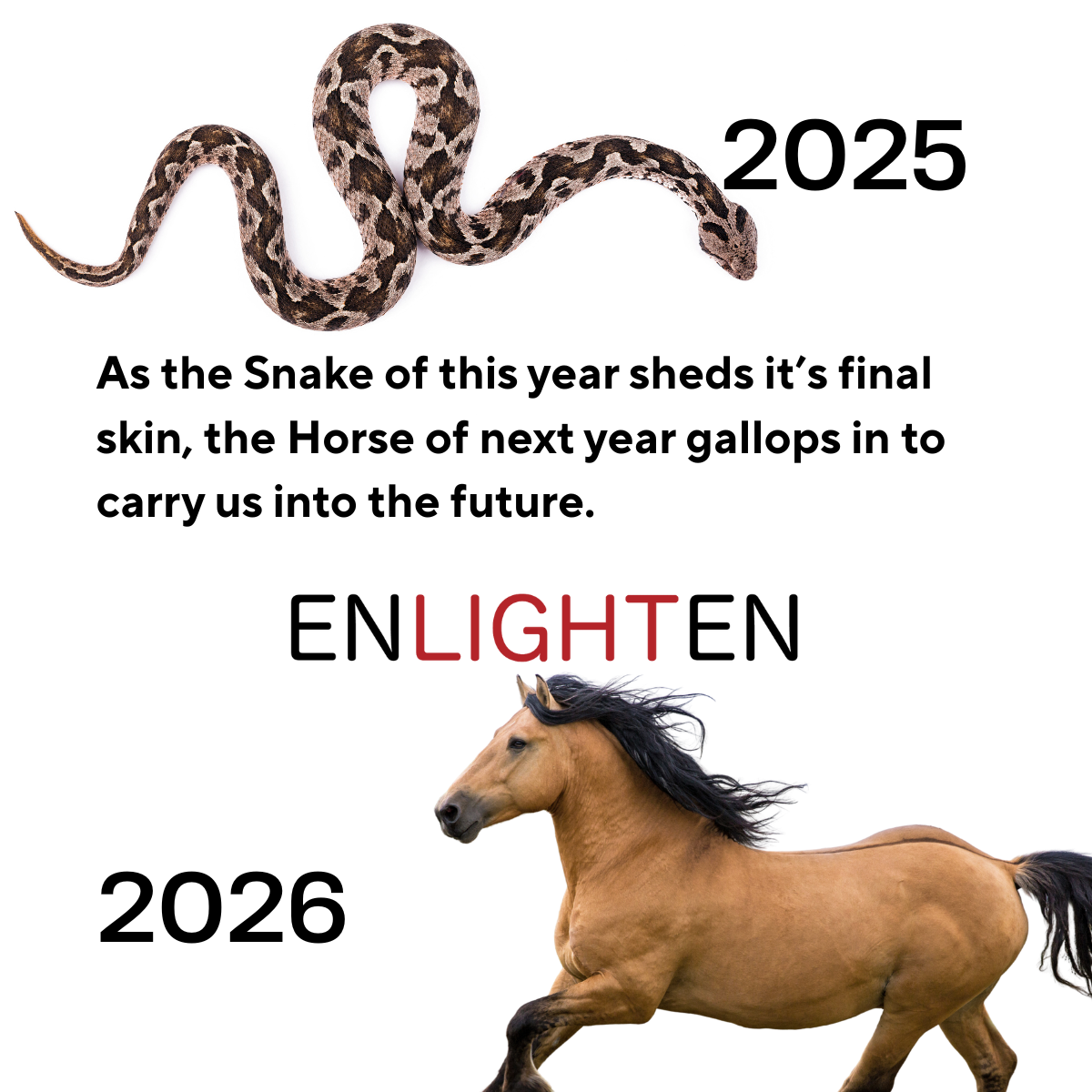
Consider the transition from the Year of the Wood Snake (2025) to the Year of the Fire Horse (2026). The Snake—sixth in the cycle—is the master of the interior world. A creature of profound intuition and strategic patience. Its most powerful act, the shedding of its skin, is a primal metaphor for the soul's necessary rite of passage: the deliberate release of the old self, the outdated narrative, the belief that no longer serves. The Wood element in 2025 is the earth's subtle promise, it is the energy of rooting, of slow, flexible growth that builds structure deep beneath the surface [6]. This is the year of the architect, where the spirit is called to containment and refinement.
Then comes the Horse. The Horse—seventh in the cycle—is the spirit unleashed. It embodies vitality, speed, and the sheer, exhilarating force of will. The ancient phrase (mǎ dào chéng gōng) is not a wish; it is a declaration of prepared power: success arrives when the horse is ready to run. The Fire Horse of2026 is a double-fire year, a cosmic confluence that signifies drastic change and breakthrough [7] [8]. It is the year of the builder, demanding expenditure and motion.
The wisdom is in the sequence: framework precedes execution. Integration precedes expansion. To reverse this order is to court chaos—to unleash the Horse's energy before the Snake has finished its shedding is to mistake velocity for load-bearing structure. The ancestral lesson is clear: before you run, you must first know what you are running from, and what you are running toward.
The Snake sheds because growth requires release. The Horse runs only after the ground is prepared to carry its weight.
The Cross-Cultural Consensus on Temporal Hygiene
One of the most compelling arguments for year-end reflection is anthropological. Across cultures separated by geography and belief, the same core behaviors appear at the turning of the year. Homes are cleaned, accounts settled, ancestors honored, and stories told. These practices appear in Lunar New Year traditions across East Asia, in Nowruz celebrations in Persia, and in customs tied to the Gregorian calendar [1]. This convergence is not coincidental; practices that persist for millennia do so because they have been proven beneficial in solving real problems. In this case, the problem is temporal coherence. Humans need a mechanism to metabolize experience before stepping into what comes next. Narrative identity research confirms this, showing that people make sense of their lives by constructing evolving stories that integrate the past with the present and future. When that narrative fragments, decision-making deteriorates. Reflection repairs the narrative by updating it with evidence, not aspiration [3] [9]. What ancient ritual accomplished symbolically, structured reflection now accomplishes cognitively.
Personal Myth Is Infrastructure, Not Decoration
The term “personal myth” refers to the internal story that explains who you are, what has happened, and what is now possible. This story exists whether it is examined or not. Left unexamined, it calcifies around outdated roles and unresolved narratives. People often behave as if they are still versions ofthemselves that no longer serves them, carrying assumptions that no longer apply. The cost appears as burnout, repeated mistakes, and a chronic, unplaceable dissatisfaction.
Year-end reflection is a rare practice that reliably updates this internal story. By reviewing what actually occurred successes, failures, and tradeoffs the narrative becomes more accurate. Accuracy, not optimism, is what improves agency. Ancient cultures understood this. Reflection was not about self-improvement; it was about coherence. Modern research confirms the principle: an integrated identity supports better choices, greater resilience, and more sustainable effort [3] [10]. The transition from the Wood Snake to the Fire Horse offers a useful lens—not as belief, but as structure. First comes review, shedding, and design. Then comes movement, risk, and execution. Reversing that order produces motion without direction.
Across history, culture, and science, the agreement is striking. Before moving forward, the past must be accounted for. Not honored, not romanticized. Integrated. The Snake sheds. Then the Horse runs. Anything else is velocity without a true path forward. Are you ready to release what no longer serves you (inflammation, pain, stress, high toxic load) and move forward into the best version of you (feeling good mentally, physically, emotionally, and about yourself)? Book your next session today!
We have also added a custom GPT year end reflection exercise that will help you review, distill, shed, and ready the ground for the emerging year. This is a free and private tool just for you. Click the link below and say hello to 2026!
Works Cited
[1] Britannica. (n.d.). New Year festival.
Full URL: https://www.britannica.com/topic/New-Year-festival
[2] UNESCO. (n.d.). Nowruz: Celebrating the New Year on the Silk Roads.
Full URL: https://en.unesco.org/silkroad/content/nowruz-celebrating-new-year-silk-roads
[3] He, W., & Gan, J. (2025). The relationship between self-reflection and mental health: A meta-analysis review. Current Psychology, 44(5), 3899-3913.
Full URL: https://link.springer.com/article/10.1007/s12144-025-07415-9
[4] American Psychological Association. (n.d.). Speaking of Psychology: The healing power of expressive writing.
Full URL: https://www.apa.org/news/podcasts/speaking-of-psychology/expressive-writing
[5] Locke, E. A., & Latham, G. P. (2002). Building a practically useful theory of goal setting and task motivation. American Psychologist, 57(9), 705-717.
Full URL: https://psycnet.apa.org/record/2002-15790-003
[6] Zhao, X. (2025, January 23). Lunar New Year 2025: what does Year of the Snake mean?. The University of Sydney.
[7] Zhao, R. (2025, August 29). Year of the Horse: Horoscope 2025/2026, Personality. China Highlights.
Full URL: https://www.chinahighlights.com/travelguide/chinese-zodiac/horse.htm
[8] Jin, S., & Kwong, K. (2025, December 8). Why the Year of the Horse 2026 could bring chaos but also great progress. South China Morning Post.
[9] McAdams, D. P. (2001). The psychology of life stories. Review of General Psychology, 5(2), 100-122.
Full URL: https://journals.sagepub.com/doi/10.1037/1089-2680.5.2.100
[10] American Psychological Association. (2020). Building your resilience.
Full URL: https://www.apa.org/topics/resilience/building-your-resilience